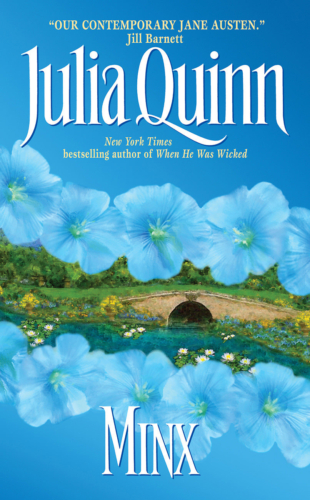





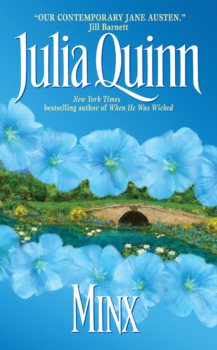
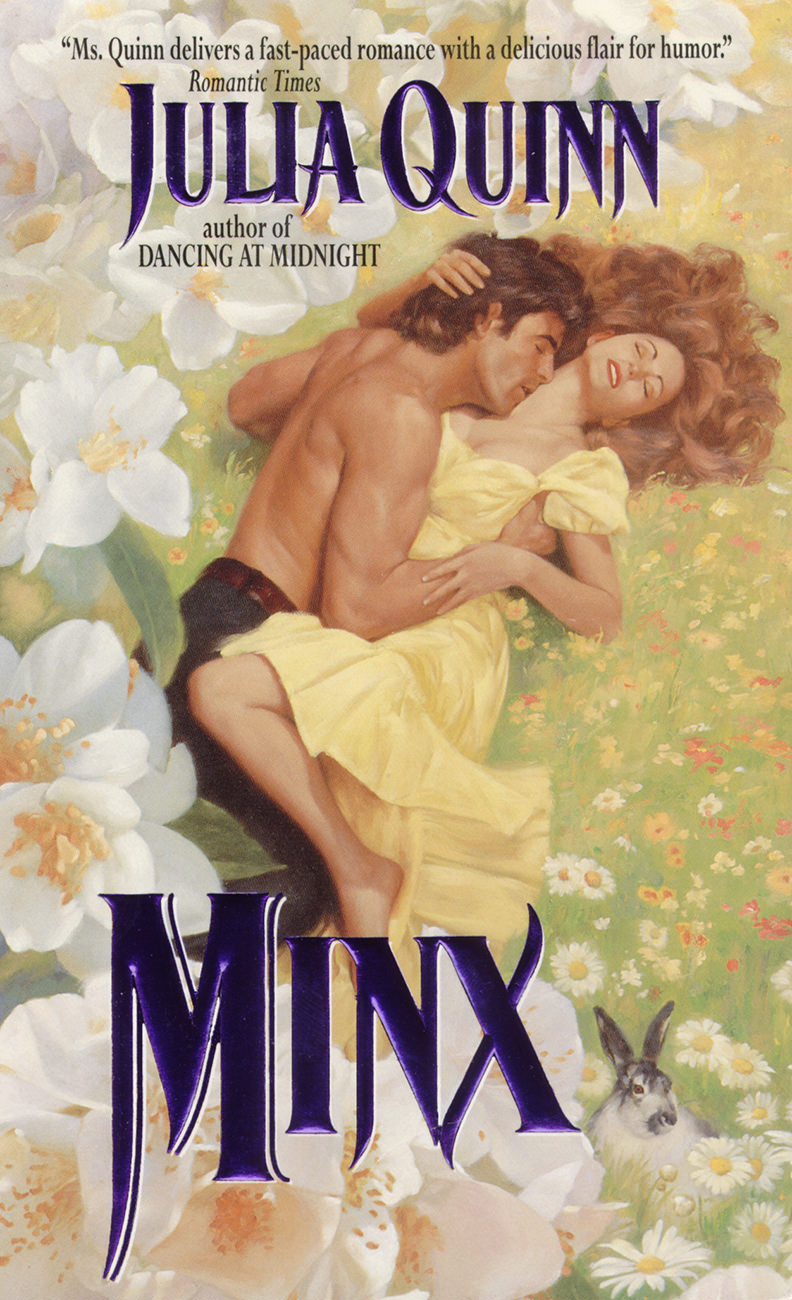
Minx
Book 3 in the
Splendid Trilogy
It takes a minx to tempt a rogue…
Henrietta Barrett has never followed the dictates of society. She manages her elderly guardian’s remote Cornwall estate, wears breeches instead of frocks, and answers to the unlikely name of Henry. But when her guardian passes away, her beloved home falls into the hands of a distant cousin.
…and it takes a rogue to tame her
William Dunford, London’s most elusive bachelor, is stunned to learn that he’s inherited property, a title… and a ward bend on making his first visit his last. Henry is determined to continue running Stannage Park without help from the handsome new lord, but Dunford is just as sure he can change things… starting with his wild young ward. But turning Henry into a lady makes her not only the darling of the ton, but an irresistible attraction to the man who thought he could never be tempted.
The final book in the Blydon Family Saga - the first ever Regency romance trilogy written by Julia Quinn, author of the global phenomenon Bridgerton.
 Start Reading Now
Explore Inside this Story

-
Quinn-tessential Quote
You don't always have to kiss a lot of frogs to recognize a prince when you find one.
-
Inside the Story:
JQ’s Author Notes- Check out Dunford in How To Marry a Marquis. He's got a minor (but fun!) part. Even though How To Marry a Marquis was written after Minx, it takes place several years earlier, so Dunford is still very much a rakish bachelor. It was kind of fun to write his scene, all the while thinking, "Heh heh, you have NO idea what I've got in store for you!"
- Unfortunately, I found out that the Brazilian-Portuguese translator of How To Marry a Marquis swapped Dunford's name with that of the villain. I was aghast! Now one of my nicest heroes is attacking women! (But only in Brazil.) I am happy to report, however, that the errant version of Como se casar com um marquês is now out of print, a new version was published in Brazil in 2021, and Dunford is back to his gentlemanly ways.
- Charles Wycombe, the hero of Brighter Than the Sun, is a very minor character in Minx and mentions that he needs to marry soon. When I wrote Minx, I had no idea what his desperate situation was, but I figured it would be a great set-up for another book.
- Rufus the bunny was inspired by my own houserabbit, Rutherford (Rufie for short.) Unlike Rufus, my sweet bunny has never chewed up important documents. (He did, however, take a big chunk out of a Lisa Kleypas novel.)
Bonus Features


Enjoy an Excerpt
from
Minx
Prologue
William Dunford snorted with disgust as he watched his friends gaze longingly into each other’s eyes. Lady Arabella Blydon, one of his best friends these past two years, had just gotten herself married to Lord John Blackwood, and now they were looking at each other as if they wanted to eat each other up. It was revoltingly cute.
Dunford tapped his foot and rolled his eyes, hoping that they would be able to tear themselves apart. The three of them, along with Dunford’s best friend Alex, the Duke of Ashbourne, and his wife Emma, who happened to be Belle’s cousin, were on their way to a ball. Their carriage had met with a mishap, and they were presently waiting for a fresh one to be brought around.
At the sound of wheels rolling along the cobbles, Dunford turned. The new carriage pulled up to a halt in front of them, but Belle and John didn’t appear to notice. In fact, they almost looked as if they were ready to throw themselves into each other’s arms and make love on the spot. Dunford decided that he had had enough. “Yoo-hoo!” he called out in a nauseatingly sweet voice. “Young lovers!”
John and Belle finally tore their eyes off one another and turned, blinking, to Dunford, who was making his way toward them.
“If the two of you can stop making verbal love to each other, we can be on our way. In case you hadn’t noticed, the fresh carriage is here.”
John took a deep and ragged breath before turning to Dunford and saying, “Tact, I take it, was not emphasized in your upbringing.”
Dunford smiled merrily. “Not at all. Shall we be off?”
John turned to Belle and offered her his arm. “My dear?”
Belle accepted his gesture with a smile, but as they passed Dunford, she turned and hissed, “I’m going to kill you for this.”
“I’m sure you’ll try.” The quintet was soon settled into the new carriage. After a few moments, however, John and Belle were gazing rapturously at each other again. John laid his hand on hers and tapped his fingers against her knuckles. Belle let out a little mewl of contentment.
“Oh, for God’s sake!” Dunford exclaimed, turning to Alex and Emma. “Will you look at them? Even the two of you weren’t this nauseating.”
“Someday,” Belle said in a low voice, her finger jabbing at him, “you’re going to meet the woman of your dreams, and then I’m going to make your life miserable.”
“Afraid not, my dear Arabella. The woman of my dreams is such a paragon she couldn’t possibly exist.”
“Oh, please,” Belle snorted. “I bet that within a year you’ll be tied up, leg-shacked, and loving it.” She sat back with a satisfied smile. Beside her John was shaking with mirth.
Dunford leaned forward, resting his elbows on his knees. “I’ll take that bet. How much are you willing to lose?”
“How much are you willing to lose?”
Emma turned to John. “You seem to have married a gambling woman.”
“Had I known, you can be sure I would have weighed my actions more carefully.”
Belle gave her new husband a playful jab in the ribs as she leveled a quelling stare at Dunford and asked, “Well?”
“A thousand pounds.”
“Done.”
“Are you crazy?” John exclaimed.
“Am I to assume that only men can gamble?”
“Nobody makes such a fool’s bet, Belle,” John said. “You’ve just made a wager with the man who controls the outcome. You can only lose.”
“Don’t underestimate the power of love, my dear. Although in Dunford’s case, perhaps only lust will do.”
“You wound me,” Dunford replied, placing his hand dramatically over his heart for emphasis. “Assuming I am incapable of the higher emotions.”
“Aren’t you?”
Dunford’s lips clamped together in a thin line. Was she right? He really had no idea. Either way, in a year’s time he’d be a thousand pounds richer. Easy money.
Chapter One
A few months later, Dunford was sitting in his salon, taking tea with Belle. She had just stopped by to chat; he was glad for this unexpected visit since they didn’t see quite as much of each other now that she was married.
“Are you certain that John isn’t going to come barging over here with a gun and call me out?” Dunford teased.
“He’s too busy for that sort of nonsense,” she said with a smile.
“Too busy to indulge his possessive nature? How odd.”
Belle shrugged. “He trusts you, and more importantly, he trusts me.”
“A veritable paragon of virtue,” Dunford said dryly, telling himself that he was not in the least bit jealous of his friend’s marital bliss. “And how-”
A knock sounded on the door. They looked up to see Whatmough, Dunford’s unflappable butler, standing in the doorway. “A solicitor has arrived, sir.”
Dunford raised a brow. “A solicitor, you say. I cannot fathom why.”
“He is most insistent, sir.”
“Show him in, then.” Dunford turned to Belle and gave her a what-do-you-suppose-this-could-be shrug.
She smiled mischievously. “Intriguing.”
“I’ll say.”
Whatmough ushered the solicitor in. A graying man of medium stature, he looked very excited to see Dunford. “Mr. Dunford?”
Dunford nodded.
“I cannot tell you how glad I am to have finally located you,” the solicitor said enthusiastically. He looked at Belle with a puzzled expression. “And is this Mrs. Dunford? I was led to believe that you were not married, sir. Oh, this is odd. Most odd.”
“I’m not married. This is Lady Blackwood. A friend. And you are?”
“Oh, I’m sorry. Most sorry.” The solicitor took out a handkerchief and patted his brow. “I am Mr. Percival Leverett, of Cragmont, Hopkins, Topkins, and Leverett.” He leaned forward, adding extra emphasis when he said his name. “I have very important news for you. Most important indeed.”
Dunford waved his arms expansively. “Let’s hear it, then.”
Leverett glanced over at Belle and then back at Dunford. “Perhaps we should speak privately, sir? Since she is not a relation.”
“Of course.” Dunford turned to Belle. “You don’t mind, do you?”
“Oh, not at all,” she assured him, her smile saying that she would have a thousand questions ready when they were through. “I’ll wait.”
Dunford motioned toward a door leading to his study. “Right through here, Mr. Leverett.”
They left the room, and Belle was delighted to note that they did not shut the door properly. She immediately stood up and moved to the chair closest to the slightly open door. She craned her neck, her ears pricking up immediately.
A mumble of voices.
More mumble.
And then, from Dunford – “My cousin who?”
Mumble, mumble.
“From where?”
Mumble, mumble, something that sounded like Cornwall.
“How many times removed?”
No, that couldn’t have been eight that she heard.
“And he left me what?”
Belle clapped her hands together. How delightful. Dunford had just come into an unexpected inheritance. She rather hoped it was something good. One of her friends had just unwillingly inherited thirty-seven cats.
The rest of the conversation was impossible to decipher. After a few minutes the two men emerged and shook each other’s hands. Leverett shoved a few papers into his case and said, “I’ll have the rest of the documents sent over as soon as possible. We’ll need your signature, of course.”
“Of course.”
Leverett nodded and exited the room.
“Well?” Belle demanded.
Dunford blinked a few times, as if he still couldn’t quite believe what he’d just heard. “I seem to have inherited a barony.”
“A barony! Goodness, I’m not going to have to call you Lord Dunford now, am I?”
He rolled his eyes. “When was the last time I called you Lady Blackwood?”
“Not ten minutes ago,” she pointed out pertly. “When you introduced me to Mr. Leverett.”
“Touche, Belle.” He sank down onto the sofa, not even waiting for her to seat herself first. “I suppose you may call me Lord Stannage.”
“Lord Stannage,” she murmured. “How perfectly distinguished. William Dunford, Lord Stannage.” She smiled devilishly. “It is William, isn’t it?”
Dunford snorted. He was so rarely called by his first name that they had a long-running joke that she couldn’t remember it. “I asked my mother,” he finally replied. “She said she thinks it’s William.”
“Who died?” Belle asked baldly.
“Ever brimming with tact and refinement, my dear Arabella.”
“Well, you obviously cannot be grieving overmuch over the loss of your, er, distant relative, since you didn’t even know of his existence until now.”
“A cousin. An eighth cousin, to be exact.”
“And they couldn’t find anyone more closely related?” she asked disbelievingly. “Not that I begrudge you your good fortune, of course, but it is quite a stretch.”
“We seem to be a family of fillies.”
“Nicely put,” she muttered sarcastically.
“Metaphors aside,” he said, ignoring her jibe, “I am now in possession of a title and a small estate in Cornwall.”
So she had heard correctly. “Have you ever been to Cornwall?”
“Never. Have you?”
She shook her head. “I hear it’s quite dramatic. Cliffs and crashing waves and all that. Very uncivilized.”
“How uncivilized could it be, Belle? This is England, after all.”
She shrugged. “Are you going to go down for a visit?”
“I suppose I must.” He tapped his finger against his thigh. “Uncivilized, you say? I’ll probably adore it.”
“I hope he hates it here,” Henrietta Barrett said, taking a vicious bite of her apple. “I hope he really hates it.”
“Now, now, Henry,” Mrs. Simpson, the housekeeper of Stannage Park, said with a cluck. “That isn’t very charitable of you.”
“I’m not feeling terribly charitable at the moment. I’ve put a lot of work into Stannage Park.” Henry’s eyes glowed wistfully. She had lived here in Cornwall since the age of eight, when her parents had been killed in a carriage accident in their home town of Manchester, leaving her orphaned and penniless. Viola, the late baron’s late wife, had been her grandmother’s cousin and graciously agreed to take her in. Henry had immediately fallen in love with Stannage Park, from the pale stone of the building to the shimmering windows to every last tenant who lived on the property. The servants had even found her polishing the silver one day. “I want everything to sparkle,” she had said. “It has to be perfect, for this is truly a perfect place.”
And so Cornwall had become her home, more so than Manchester had ever been. Viola had doted on her, and Carlyle, her husband, became a sort of distant father figure. He didn’t spend a lot of time with her, but he always had a friendly pat on the head ready when she passed him in the hall. When she was fourteen, however, Viola died, and Carlyle was desolate. He retreated into himself, letting the details of running the estate flounder.
Henry had immediately stepped in. She loved Stannage Park as much as anybody and had firm ideas as to how it should be run. For the last six years she had been not only the lady of the manor but the lord as well, universally accepted as the person in charge. And she liked her life just fine.
But Carlyle had died, and the estate and title had passed on to some distant cousin in London who was probably a fop and a dandy. He’d never been to Cornwall before, she’d heard, conveniently forgetting that she’d never been here either, before she’d arrived twelve years ago.
“What was his name again?” Mrs. Simpson asked, her capable hands kneading dough for bread. “Dunford. Something-or-other Dunford,” Henry said in a disgusted voice. “They didn’t see fit to inform me of his first name. Although I suppose it doesn’t matter now that he is Lord Stannage. He’ll probably insist that we use the title. Newcomers to the aristocracy usually do.”
“You talk as if you’re a member of it yourself, Henry. Don’t be turning your nose up at the gentleman.”
Henry sighed and took another bite of her apple. “He’ll probably call me Henrietta.”
“As well he should. You’re getting too old for Henry now.”
“You call me Henry.”
“I’m too old to change. But you’re not. And it’s high time you lost your hoydenish ways and found yourself a husband.”
“And do what? Move off to England? I don’t want to leave Cornwall.”
Mrs. Simpson smiled and forebore to point out that Cornwall was indeed a part of England. Henry was so devoted to the region that she could not think of it as belonging to any greater whole. “There are gentlemen here in Cornwall, you know,” she pointed out. “Quite a few in the nearby villages. You could marry one of them.”
Henry scoffed. “There is no one here worth his salt and you know it, Simpy. Besides, no one would have me. I haven’t a shilling now that Stannage Park has gone off to this stranger, and they all think I’m a freak.”
“Of course they don’t!” Mrs. Simpson replied quickly. “Everyone looks up to you.”
“I know that,” Henry replied, rolling her silver-gray eyes. “They look up to me as if I were a man, and for that I’m grateful. But men don’t want to marry other men, you know.”
“Perhaps if you’d wear a dress…”
Henry looked down at her well-worn breeches. “I do wear a dress. When appropriate.”
“I can’t imagine when that is,” Mrs. Simpson snorted. “Since I’ve never seen you in one. Not even at church.”
“How fortunate for me that the vicar is a most open-minded gentleman.”
Simpy leveled a shrewd gaze at the younger woman. “How fortunate for you that the vicar is overfond of the French brandy you send over once a month.
” Henry pretended not to hear. “I wore a dress to Carlyle’s funeral, if you recall. And to the county ball last year. And whenever we receive guests. I have at least five in my closet, thank you very much. Oh, and I also wear them to town.”
“You do not.”
“Well, perhaps not to our little village, but I do whenever I go to any other town. But anyone would agree that they are most impractical when I’m out and about overseeing the estate.” Not to mention, Henry thought wryly, that they all looked dreadful on her.
“Well, you’d better get one on when Mr. Dunford arrives.”
“I’m not completely daft, Simpy.” Henry chucked the apple across the kitchen into a bucket of scraps. It fell squarely in, and she let out a whoop of pride. “Haven’t missed that bucket in months.”
Mrs. Simpson shook her head. “If only someone would teach you how to be a girl.”
“Viola tried,” Henry replied cheekily. “And she might have succeeded if she’d lived longer. But the truth is, I like myself just fine.” Most of the time, at least, she thought. Every now and then she’d see a fine lady in a gorgeous gown that fit her to perfection. Such women didn’t have feet, Henry decided. They had rollers – virtually gliding along. And wherever they went, a dozen besotted men followed. Henry would wistfully stare at this entourage, imagining them mooning after her. Then she laughed. That particular dream wasn’t likely to come true, and besides, she liked her life just fine, didn’t she?
“Henry?” Mrs. Simpson said, leaning forward. “Henry, I was talking to you.”
“Hmmm?” Henry blinked herself out of her reverie. “Oh, I’m sorry, I was just thinking about what to do about the cows,” she lied. “I’m not sure we’ve got enough room for all of them.”
“You should be thinking about what to do when Mr. Dunford arrives. He did send word that it would be this afternoon, didn’t he?”
“Yes, blast him.”
“Henry!” Mrs. Simpson said reprovingly.
Henry shook her head and sighed. “If ever there was a time for cursing, it’s now, Simpy. What if he wants to take an interest in Stannage Park? Or worse – what if he wants to take charge?”
“If he does, it will be his right. He does own it, you know.”
“I know, I know. More’s the pity.”
Mrs. Simpson shaped the dough into a loaf and then set it aside to rise. Wiping off her hands, she said, “Maybe he’ll sell it. If he sold it to a local you wouldn’t have anything to worry about. Everyone knows there’s nobody better to manage Stannage Park than you.”
Henry hopped down from her perch on the counter, planted her hands on her hips, and began to pace across the kitchen. “He can’t sell. It’s entailed. If it weren’t, I daresay Carlyle would have left it to me.”
“Oh. Well, then you’re just going to have to do your best to get along with Mr. Dunford, then.”
“That’s Lord Stannage now,” Henry groaned. “Lord Stannage – owner of my home and decider of my future.”
“Just what does that mean?”
“It means that he’s my guardian.”
“What?” Mrs. Simpson dropped her rolling pin.
“I’m his ward.”
“But… but that’s impossible. You don’t even know the man.”
Henry shrugged. “It’s the way of the world, Simpy. Women haven’t brains, you know. We need guardians to guide us.”
“I can’t believe you didn’t tell me.”
“I don’t tell you everything, you know.”
“Just about,” Mrs. Simpson snorted.
Henry smiled sheepishly. It was true that she and the housekeeper were much closer than one would expect. She absently twirled her fingers around a lock of her long brown hair, one of her few concessions to vanity. It would have been more sensible to cut it short, but it was thick and soft, and Henry just couldn’t bear to part with it. Besides, it was her habit to wind it around her fingers while she was thinking hard about a problem, as she was doing now.
“Wait a minute!” she exclaimed.
“What?”
“He can’t sell the place, but that doesn’t mean he has to live here.”
Mrs. Simpson narrowed her eyes. “I’m not certain I understand your meaning, Henry.”
“We just have to make sure that he absolutely, positively doesn’t want to live here. Chances are it won’t be difficult. He’s probably one of those soft London sorts. But it certainly couldn’t hurt to make him slightly, er, uncomfortable.”
“What on earth are you thinking of, Henrietta Barrett? Putting rocks in the poor man’s mattress?”
“Nothing so crude, I assure you,” Henry scoffed. “We shall show him every kindness. We shall be politeness personified. But we shall endeavor to point out that he is not suited for country life. He could learn to love the role of absentee landlord. Especially if I send him quarterly profits.”
“I thought you poured the profits back into the estate.”
“I do. But I’ll just have to split them in half. I’ll send half to the new Lord Stannage and reinvest half here. I won’t like doing it, but it will be better than having him in residence.”
Mrs. Simpson shook her head. “Just what exactly are you planning to do to him?”
Henry twirled her finger in her hair. “I’m not certain. I’ll have to give it some thought.”
Mrs. Simpson looked over at a clock. “You’d better think fast, because he’ll be here within the hour.”
Henry walked over to the door. “I’d better wash.”
“If you don’t want to meet him smelling like the great outdoors,” Mrs. Simpson retorted. “And not the part with flowers and honey, if you know what I mean.”
Henry shot her a cheeky grin. “Will you have someone fill a bath for me?” At the housekeeper’s nod, she dashed up the back stairs. Mrs. Simpson was right. She smelled rather unsavory. But then, what could one expect after a morning overseeing the construction of a new pigpen? It had been messy work, but Henry had been glad to do it. Or rather, she admitted to herself, to supervise it. Getting knee deep in muck was not exactly her thing.
She stopped suddenly on the stairs, her eyes lighting up. It was not her thing, but it was just the thing for the new Lord Stannage. She could even bring herself to get more actively involved in the project if it meant convincing this Dunford fellow that this was what country lords did all the time.
Feeling much enthused, she bounded up the rest of the stairs to her bedroom. It would be several minutes before the tub was filled, so she picked up her hairbrush and walked over to the window to look out. Her hair had been pulled back like a pony’s tail, but the wind had whipped it into snarls. She untied the ribbon; it would be easier to wash detangled.
As she pulled the brush through her hair, she stared out over the green fields surrounding the house. The sun was just beginning to set, tinting the sky like a peach. Henry sighed with love. Nothing had the power to move her like these lands.
Then, as if timed just to spoil her perfect moment, something glinted on the horizon. Oh, God, it wasn’t– It was glass. Glass from a carriage window. Damn and blast – he was early. “Stupid wretch,” she muttered. “Deuced inconsiderate of him.” She glanced back over her shoulder. Her bath wasn’t ready.
Pressing closer to the window, she peered down at the carriage that was now rolling down the drive. It was quite elegant. Mr. Dunford must have been a man of some means even before inheriting Stannage Park. Either that or he had wealthy friends willing to loan him a conveyance. Henry stared at the scene quite unabashedly, brushing her hair all the while.
Two footmen dashed out to unload the trunks. She smiled proudly. She had this house running like clockwork. Then the carriage door opened. Without realizing it, she moved even closer to the glass of her window. A booted foot emerged. A rather nice, manly boot, Henry observed, and she knew her boots. Then it became apparent that the boot was attached to a leg that was every bit as manly as its footwear. “Oh, dear,” she muttered. He wasn’t going to be a weakling. Then the owner of the leg hopped out, and she saw him in his entirety.
She dropped her hairbrush.
“Oh, my God,” she breathed. He was beautiful. No, not beautiful, she corrected, for that would imply some sort of effeminate quality, and this man certainly had none of that. He was tall, with a firmly muscled body and broad shoulders. His hair was thick and brown, slightly longer than was fashionable. And his face… Henry may have been looking down at him from fourteen feet up, but even she could see that his face was everything a face ought to be. His cheekbones were high, his nose straight and strong, and his mouth finely molded with a slight wry quality to it. She couldn’t see what color his eyes were, but she had a sinking feeling that they would be filled with shrewd intelligence. And he was much, much younger than she’d expected. She’d been hoping for someone in his fifties. This man couldn’t be a day over thirty.
Henry groaned. This was going to be much harder than she’d anticipated. She was going to have to be very crafty indeed to fool this one. With a sigh, she reached down for her hairbrush and walked back to her bath.
As Dunford was quietly inspecting the front of his new home, a movement in an upstairs window caught his eye. The sun was glinting off the glass, but it appeared to be a girl with long, brown hair. Before he could get a better look, however, she’d turned and disappeared into the room. That was odd. No servant would be standing idle by a window at this time of day, especially with her hair unbound. He wondered briefly who she was, then let the thought drift from his mind. He’d have time enough to find out about her. Right now he had more important things to attend to.
The entire staff of Stannage Park had assembled in front of the house for his inspection. There were about two dozen altogether – a small number by ton standards, but then again Stannage Park was a fairly modest home for a peer of the realm. The butler, a thin man named Yates, was taking great pains to make the process as formal as possible. Dunford tried to humor him by adopting a slightly austere manner; it seemed to be what the servants expected of the new lord of the manor. It was hard to suppress a smile, however, as maid after maid bobbed a curtsy in his honor. He had never expected a title, never expected lands of his own or a household to go with it. His father had been a younger son of a younger son; God only knew how many Dunfords had had to die to put him in line for this inheritance.
After the last maid had bobbed up and down, Dunford returned his attention to the butler. “You run an excellent house, Yates, if this introduction is any indication.”
Yates, who had never acquired the stone-faced facade that was a prerequisite among London butlers, flushed with pleasure. “Thank you, my lord. We do try as hard as we can, but it’s Henry we’d have to thank.”
Dunford raised a brow. “Henry?”
Yates gulped. He should have called her Miss Barrett. That’s what the new Lord Stannage would expect, him being from London and all that. And he was Henry’s new guardian, wasn’t he? Mrs. Simpson had pulled him aside and whispered that particular tidbit in his ear not ten minutes ago. “Umm, Henry is…” His voice trailed off. It was so hard to think of her as anything but Henry. “That is to say…”
But Dunford’s attention had already been captured by Mrs. Simpson, who was assuring him that she had been at Stannage Park for over twenty years and knew everything about the estate, well, at least about the house, and if he needed anything…
Dunford blinked as he tried to focus on the housekeeper’s words. Dimly he sensed that she was nervous. That was probably why she was rattling on like a… like a something. What exactly he didn’t know, and what was she saying? A flash of movement in the stables caught his eye and he allowed his gaze to wander in that direction. He waited a moment. Oh, well, he must have imagined it. He turned back to the housekeeper. She was saying something about Henry. Who was Henry? The question formed on his tongue and would have rolled off his lips if a giant pig hadn’t suddenly exploded out through the partially open door of the stables.
“Holy, bloody…” Dunford breathed, unable to complete his curse. He was mesmerized by the sheer ludicrousness of the situation. The creature was hurtling across the lawn moving faster than any pig had a right to. It was an enormous porcine beast – surely that was all one could call it – this was no ordinary swine. Dunford had no doubt it would feed half the ton if taken to a proper butcher.
The pig reached the assembly of servants, and the maids shrieked, running in every possible direction. The pig, stunned by the sudden movement, stopped, raised its snout, and let out a hellish squeal. And then another, and another, and…
“Will you shut up!” Dunford commanded.
The pig, sensing authority, didn’t just shut up – it actually laid down.
Henry did a double-take, impressed in spite of herself. She had dashed downstairs the minute she saw the pig emerge from the stables and had arrived in the front drive just as the new Lord Stannage was trying out his new lordly imperiousness on barnyard animals.
She ran forward, forgetting that she hadn’t managed to take that bath she knew she needed, forgetting that she was still garbed in boys’ clothes. Dirty boys’ clothes.
“So sorry, my lord,” she muttered, offering him a tight smile before leaning down and grabbing the pig’s collar. She probably shouldn’t have interfered, should have let the pig get bored of sitting on the ground, should have laughed when it came forward and did unspeakable things to the new Lord Stannage’s boots. But she took far too much pride in Stannage Park not to try to salvage the disaster in some way. There was nothing in the world that meant as much to her as this smoothly running estate, and she couldn’t bear that someone might think that free-roaming pigs were a common occurrence, even if that someone was a London lord of whom she heartily wanted to be rid.
A farmhand ran up, took the pig from her, and led it back to the stables. Henry straightened, suddenly aware of the way every last servant was gaping at her, and wiped her hands on her breeches. She glanced over at the darklyhandsome man standing across from her. “How do you do, Lord Stannage?” she said, curving her lips into a welcoming smile. After all, there was no need for him to realize that she was trying to scare him away.
“How do you do, Miss, er…”
Henry’s eyes narrowed. He didn’t realize who she was? No doubt he’d been expecting his ward to be a trifle younger, a pampered and spoiled young miss who never ventured out of doors, much less ran an entire estate. “Miss Henrietta Barrett,” she said in a tone that said that she expected him to recognize the name. “But you can just call me Henry. Everybody does.”
Minx
by Julia Quinn
is available in the following formats:
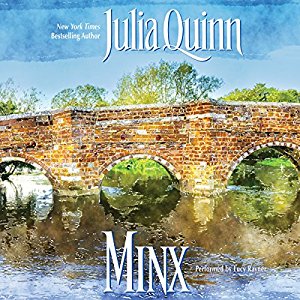

Mass Market Paperback:
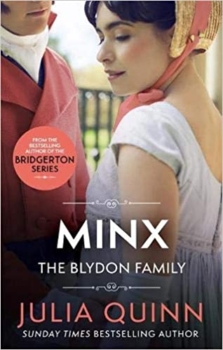
UK Edition

En Español

Not ready to order yours? Check out this story's overview. Read the excerpt. Listen to a bit on audio. Find out more about the series. There’s so much to love!
As an Amazon Associate I earn from
qualifying
purchases. I also may use affiliate links elsewhere in
my site.
Minx
Around the World:
-
French
L'insolente de Stannage Park
-
Thai

ดรุณีที่รัก
-
Polish

Odważna i zakochana
-
Hungarian
Lent délen, édes...
-
Spanish

Una mujer rebelde